
Enhancing Stability and Balance through Gaze Shift Training
balance gaze shift intervention stability Jun 14, 2024
Enhancing Balance and Stability Through Gaze-Shift Training
by Michelle C. Eliason, MS, OTR/L
Dear Members, check out your Membership Library where you have access to the Resource Bundles with your membership. I would also like to encourage you to leave a Marco Polo message for asynchronous discussion about how this content may currently relate to your clinical practice or education!
Membership Resources: This article and its companion audio are free to read and listen to. Links throughout the article connect members of the Functional Cognition Lab to related printables, treatment tools, courses, and clinical resources that align with the topic being discussed. Membership also includes access to the full resource library and direct clinical support. Find out more about membership on the Membership Options Page
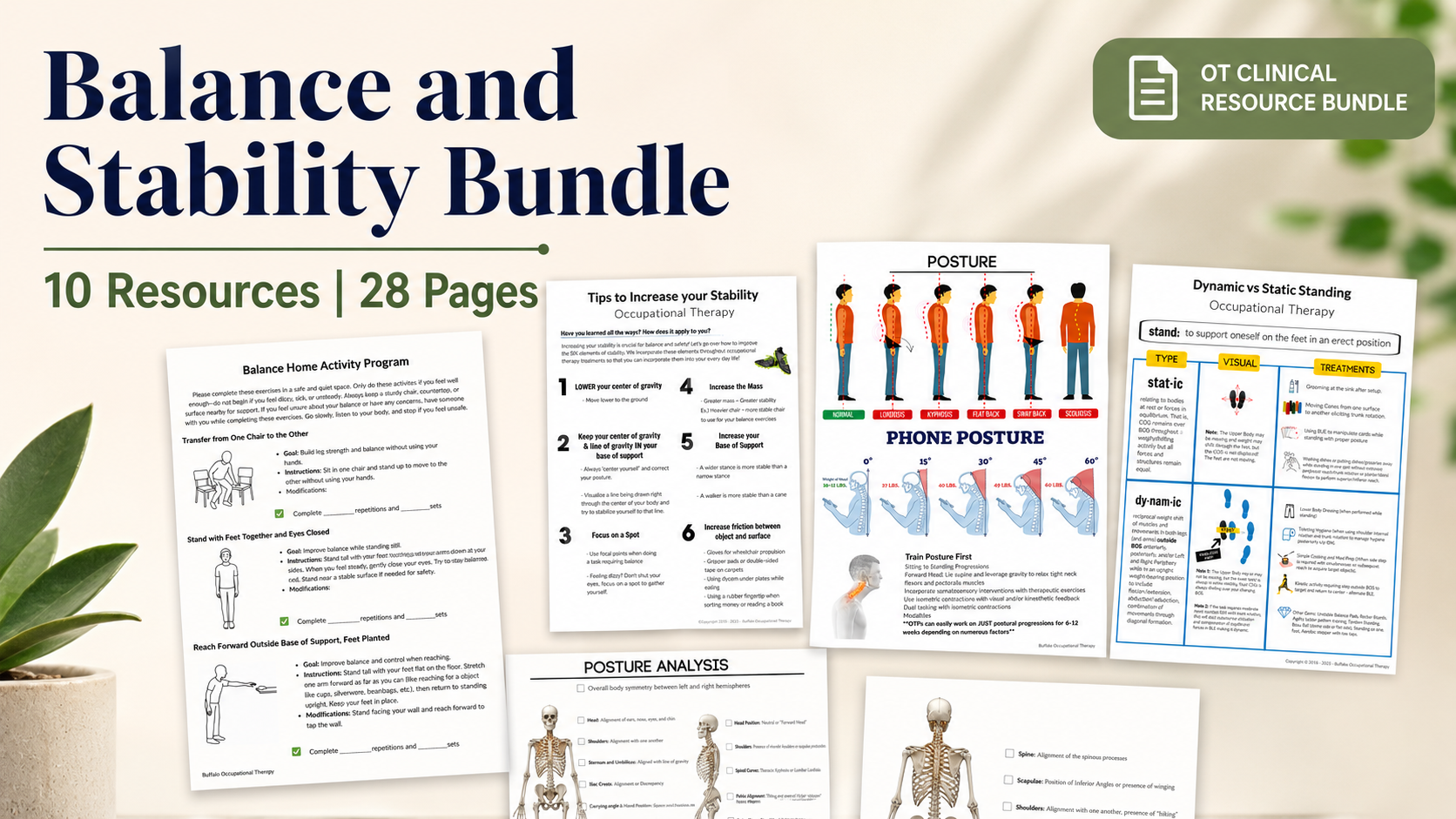
Just want the resources mentioned in this article?: Download the Balance and Stability Bundle
Helpful Resources:
- Occupational Therapy Intervention Dashboard
- Balance and Stability Goals for Neuromuscular Re-Education
- Balance and Stability in Occupational Therapy
Balance becomes much more difficult when the eyes, head, and body must move at the same time.
A person may stand safely while looking straight ahead but become unstable when asked to scan the room, shift their gaze between objects, respond to rapid instructions, or maintain balance on an uneven surface.
This is important because daily life rarely happens while a person remains still and looks in only one direction.
People shift their gaze while walking through stores, finding objects in cabinets, reading signs, crossing streets, completing household activities, navigating crowded environments, and responding to other people.
Gaze-shift training can therefore be used as part of a broader occupational therapy intervention addressing visual-motor coordination, postural control, balance reactions, sensory processing, and functional mobility.
What Is Gaze Shifting?
Gaze shifting is the ability to move the eyes quickly and accurately from one visual target to another.
This commonly involves saccadic eye movements, which are the rapid movements the eyes make when looking between objects.
Gaze shifting is different from gaze stabilization.
Gaze stabilization involves keeping an object visually clear while the head or body moves. Both skills may be challenged during rehabilitation activities, depending on how the task is designed.
In this activity, the patient shifts visual attention between targets while responding to verbal commands and maintaining balance. This creates a combined visual, cognitive, and motor challenge.
Challenging Balance on an Unstable Surface
The patient completes the activity while standing on a surface that reduces the reliability of somatosensory information from the feet and ankles.
Foam pads, wobble boards, balance boards, and similar surfaces may challenge the nervous system to rely more heavily on visual and vestibular input.
The patient must continuously adjust body position to keep the center of mass controlled over the base of support.
This may challenge:
- Ankle and hip strategies
- Trunk control
- Weight shifting
- Postural endurance
- Sensory integration
- Reactive balance
- Coordination
The unstable surface should not be used simply because it makes the activity harder. It should be selected because it targets a specific balance problem and can be completed safely.
Using Bilateral Upper-Extremity Support
The patient initially uses both upper extremities against the wall for support.
This provides a larger and more stable base from which the patient can participate in the visual and balance task. It may also reduce fear and allow the patient to focus on gaze shifting, command following, and postural adjustments.
Upper-extremity support can then be graded by changing:
- The amount of pressure placed through the hands
- The number of hands used
- The width of hand placement
- The distance from the wall
- The amount of therapist assistance
- The speed of the activity
The goal is not necessarily to remove support immediately. The goal is to provide enough support for successful practice while gradually increasing independence.
Varying the Speed of Commands
The therapist changes the rate at which commands are delivered.
A slower rate allows the patient more time to locate the target, process the instruction, shift gaze, and adjust body position.
A faster rate increases the demand on:
- Processing speed
- Visual attention
- Motor planning
- Response inhibition
- Coordination
- Postural control
- Cognitive-motor dual tasking
A rate of 30 or 50 commands per minute should not automatically be treated as better or worse. The appropriate rate depends on the patient’s abilities, accuracy, symptoms, safety, and functional goals.
Speed should only increase when the patient can maintain reasonable movement quality and postural control.
Creating the Just-Right Challenge
The therapist continuously adjusts the activity based on the patient’s response.
The task may be progressed by:
- Increasing command speed
- Increasing the distance between targets
- Adding head movement
- Reducing upper-extremity support
- Narrowing the base of support
- Changing the standing surface
- Adding reaching
- Adding memory or sequencing demands
- Increasing the duration
- Moving the activity into a functional environment
The task may be simplified by slowing the commands, reducing the number of targets, increasing hand support, returning to a stable surface, or allowing additional processing time.
This creates the just-right challenge. The patient is challenged enough to promote adaptation and learning without becoming so overwhelmed that movement quality, safety, or accuracy completely breaks down.
Functional Applications
Helpful Resource on ADLs and IADLs
This type of training may support daily activities that require a person to visually scan, respond, and remain stable at the same time.
Examples include:
- Locating items in a kitchen
- Scanning grocery shelves
- Looking between traffic signals and moving vehicles
- Finding clothing in a closet
- Following signs in a hospital or workplace
- Responding to another person while standing
- Navigating crowded environments
- Looking for obstacles during walking
- Completing household activities on variable surfaces
The activity becomes more meaningful when the therapist eventually connects it to the environments and occupations that matter to the patient.
Helpful Course on Activity Analysis: OT Scope and Structure Framework Intensive
Final Thoughts
Gaze-shift training can be much more than an eye exercise.
When combined with balance demands, changing surfaces, verbal commands, and graded support, it can challenge visual attention, sensory integration, postural control, processing speed, coordination, and cognitive-motor performance.
Research supports gaze and vestibular exercises for selected populations, particularly when visual instability, dizziness, vestibular dysfunction, or postural-control problems are present. However, outcomes vary across populations, and the activity should be matched to the patient’s specific deficits and symptoms.
The goal is not simply to stand on an unstable surface or respond to commands as quickly as possible.
The goal is to help the patient use vision, cognition, and movement together so they can remain stable while participating in real life.
About the Author
Michelle Eliason, MS, OTR/L is an occupational therapist, rehabilitation researcher, educator, and founder of BOT Portal and Buffalo Occupational Therapy. Her clinical and scholarly work focuses on neurological rehabilitation, functional cognition, cognitive-motor performance, aging, and the translation of rehabilitation science into practical occupational therapy evaluation, intervention, and clinical reasoning.
Learn more about : Michelle C. Eliason, MS, OTR/L
Continue Learning With Us
Did you find this information helpful? Please share this article with another occupational therapy practitioner, student, educator, or rehabilitation professional who may benefit from it.
Would you like access to the clinical resources discussed throughout this article? Explore our membership options to find the level of support that works best for you.
Looking for a more formal learning and mentorship experience? Learn more about the Functional Cognition Lab Mentorship Program.
You can also explore our AOTA-approved courses and clinical resource packages for additional education, treatment resources, and practical tools you can use in rehabilitation practice.
Interested in receiving free functional cognition education each week? Subscribe to the Functional Cognition Lab Newsletter.
- Loyd, B. J., Fangman, A., Peterson, D. S., Gappmaier, E., Thackeray, A., Schubert, M. C., & Dibble, L. E. (2022). Rehabilitation to Improve Gaze and Postural Stability in People With Multiple Sclerosis: A Randomized Clinical Trial. Neurorehabilitation and neural repair, 36(10-11), 678–688. https://doi.org/10.1177/15459683221124126
- Meng, L., Liang, Q., Yuan, J., Li, S., Ge, Y., Yang, J., Tsang, R. C. C., & Wei, Q. (2023). Vestibular rehabilitation therapy on balance and gait in patients after stroke: a systematic review and meta-analysis. BMC medicine, 21(1), 322. https://doi.org/10.1186/s12916-023-03029-9
- Meldrum, D., & Jahn, K. (2019). Gaze stabilisation exercises in vestibular rehabilitation: review of the evidence and recent clinical advances. Journal of neurology, 266(Suppl 1), 11–18. https://doi.org/10.1007/s00415-019-09459-x
- Cruz, T. L., Pérez, S. M., & Chiappe, M. E. (2021). Fast tuning of posture control by visual feedback underlies gaze stabilization in walking Drosophila. Current biology : CB, 31(20), 4596–4607.e5. https://doi.org/10.1016/j.cub.2021.08.041
- Guzmán-Muñoz E, Montalva-Valenzuela F, Garcia-Carrillo E, Castillo-Paredes A, López-Gil JF, Narrea Vargas JJ, Yáñez-Sepúlveda R, Concha-Cisternas Y. Postural Balance and Human Movement: An Integrative Framework for Mechanisms, Assessment, and Functional Implications. J Clin Med. 2026 Mar 28;15(7):2588. doi: 10.3390/jcm15072588. PMID: 41976890; PMCID: PMC13072877.
Categories
All Categories activities of daily living activity analysis activity tolerance goals adls advocacy arthritis attention balance brain calendars cardiovascular cardiovascular goals chronic illness chronic pain cogition cognition cognitive endurance cognitive goals cognitive load cognitive remediation cognitive science cognitive tests cognitive therapy compensation cp cva daily function goals dementia dual tasking energy conservation goals entrepreneurship errorless learning evaluations executive function exercise fascia fine motor functional ambulation functional cognition functional mobility gaze shift goal writing goals grading activities gross mobility hands high intensity high tone hit holistic holistic rehabilitation iadls idt information processing inhibition intensity interdisciplinary care interdiscipline intervention interventions journal club just-right challenge lower body manual muscle testing medicare memory memory compensation memory tools mental health michelle's phd journey mild cognitive impairment mmt neuromuscular reeducation neuroplasticity neurorehabilitation neuroscience occupational therapy older adults ot ot concepts ot students otd pain management personalization pnf posture praxis precision rehabilitation range of motion research resilience rethink ot rtss scheduling seated activity spaced retrieval therapy spasticity stability strength stretching stroke teamwork theory time perception tone traumatic brain injury treatment ideas treatment planning upper body
Join the Occupational Therapy Resource Portal