
Occupational Therapy Goals for Cognition
Aug 02, 2026
Occupational Therapy Goals for Cognition: Attention, Memory, Executive Functioning, and Functional Cognition
by Michelle C. Eliason, MS, OTR/L
Dear Members, check out your Membership Library where you have access to the Resource Bundles with your membership. I would also like to encourage you to leave a Marco Polo message for asynchronous discussion about how this content may currently relate to your clinical practice or education!
Membership Resources: This article and its companion audio are free to read and listen to. Links throughout the article connect members of the Functional Cognition Lab to related printables, treatment tools, courses, and clinical resources that align with the topic being discussed. Membership also includes access to the full resource library and direct clinical support. Find out more about membership on the Membership Options Page
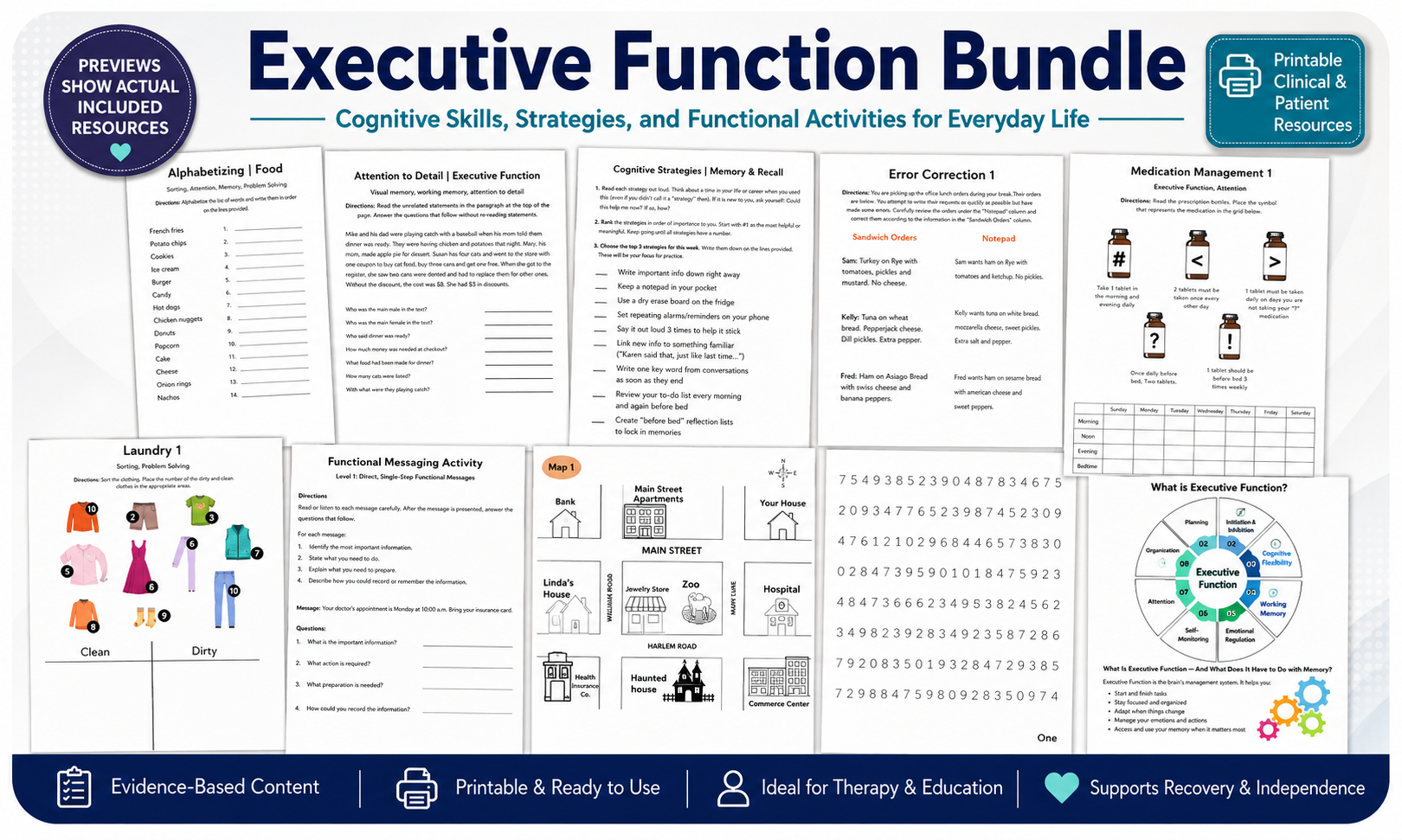
Just want the resources mentioned in this article?: Download the Executive Function Bundle
Cognition affects nearly every occupation a person performs. A participant may have difficulty remembering medication instructions, maintaining attention during meal preparation, organizing an appointment, responding when a routine changes, or recognizing an error before it creates a safety concern. These difficulties are not limited to performance on a cognitive screening. They influence how effectively the person manages health, home responsibilities, work, social participation, and community life.
Writing occupational therapy goals for cognition can be difficult because attention, memory, judgment, initiation, sequencing, and executive functioning are broad concepts. A goal that simply states that cognition will improve does not tell us what the participant will do differently, how much support will be required, or why the change matters. Strong cognition goals connect the cognitive skill to an observable behavior within a meaningful occupation.
The goal examples in this article are intended to give occupational therapy practitioners a place to begin. They should be individualized according to the participant’s occupational profile, baseline performance, diagnosis, environment, available support, expected prognosis, and plan of care. The goal should reflect the person in front of you, not simply the impairment category listed in the evaluation.
What Makes an Occupational Therapy Cognition Goal Functional?
A functional cognition goal identifies how cognitive performance affects participation in everyday life. Instead of writing that the participant will “improve memory,” the goal should explain what information must be remembered and where that information is used. Instead of stating that the participant will “increase executive functioning,” the goal should describe whether the person needs to initiate a routine, organize materials, solve a problem, shift between steps, recognize an error, or adapt when the original plan no longer works.
A well-written cognition goal generally identifies the behavior, the occupation or functional context, the expected level of accuracy or assistance, and the timeframe. Depending on the participant, it may also identify the number of steps, duration of attention, delay before recall, type of cueing, environmental demand, or strategy expected to support performance.
For example, “The participant will improve working memory” does not provide enough information to measure change. A more useful goal would be:
The participant will retain and use three pieces of verbal information during appointment planning with at least 80% accuracy and no more than one repetition within six weeks.
This version identifies the cognitive demand, the functional context, the expected performance, the support allowed, and the timeframe.
Cognition goals should also recognize that independent use of a strategy may be a meaningful outcome. A participant who consistently records appointment details, refers to a checklist, requests repetition, or stops walking before answering a complex question may be demonstrating better self-management even if the underlying impairment remains present.
6 Simple Occupational Therapy Goals for Cognition and Attention
Member resources:
- A non-inclusive list of cognitive processes for clinician
- Attention Client Resource - Describes the attentional pyramid and tips for maximizing attention.
- Occupational Profile Template
- Activity Analysis Guide
Simple goals are useful when one primary cognitive behavior is interfering with occupational performance. These goals can be used as starting templates and then modified according to the participant’s needs.
1. Insight and understanding of cognitive changes
The participant will describe at least two cognitive changes affecting daily performance and identify two strategies for managing those changes during health-management routines within six weeks.
This goal makes insight observable. The participant must identify the difficulty and connect it with strategies that can be used during everyday occupations.
2. Orientation
The participant will orient to person, place, time, and current situation with four out of four correct responses across three consecutive sessions within four weeks.
Orientation goals are most useful when orientation is directly affecting safety, participation, or the ability to follow the daily routine. The therapist should also consider whether an external support, such as a calendar, written schedule, orientation board, or labeled environment, is needed.
3. Sustained attention
The participant will sustain attention to a meaningful tabletop or household task for 20 minutes with no more than one verbal redirection within six weeks.
Duration should be selected from baseline performance and the demands of the occupation. Longer is not always better. The goal should reflect the amount of attention required for the participant’s daily activities.
4. Selective attention
The participant will complete a 15-minute functional task in the presence of moderate environmental distraction with no more than two errors and one verbal redirection within six weeks.
This may be appropriate when noise, visual clutter, conversation, or movement interferes with performance.
5. Alternating attention
The participant will alternate attention between two components of a functional activity with at least 80% accuracy and no more than two verbal cues within six weeks.
The two components should be named whenever possible. For example, the participant may alternate between reading recipe instructions and preparing ingredients, or between entering appointments and responding to functional messages.
6. Divided attention
The participant will complete a familiar mobility or household task while responding to a secondary cognitive demand for 15 minutes with no loss of safety and no more than two cues within eight weeks.
A divided-attention goal should identify what happens to both tasks. The person may maintain cognitive accuracy but become unsafe during movement, or may preserve motor performance while losing the cognitive information.
7 Occupational Therapy Goals for Memory
Member Resources: What is Memory? Patient Handout
Memory goals should identify what type of information the participant must retain, how long it must be retained, what occurs during the delay, and whether a strategy is permitted. The functional relevance should remain clear.
1. Immediate auditory recall
The participant will immediately recall four out of five details from functional verbal messages with no more than one repetition across three consecutive sessions within four weeks.
Functional messages may involve appointments, household requests, transportation information, medical instructions, or work responsibilities.
2. Delayed auditory recall
The participant will recall four pieces of functional information after a 10-minute delay with at least 80% accuracy and use of independently selected memory strategies within six weeks.
The strategy may include verbal rehearsal, written keywords, visualization, association, or entry into a phone.
3. Working memory
The participant will retain and act on three-step verbal instructions during a familiar household task with no more than one repetition across three consecutive sessions within six weeks.
This goal measures whether information can be held long enough to guide action rather than whether it can simply be repeated.
4. Memory with interference
The participant will recall four out of five items after completing a five-minute unrelated cognitive or motor activity with no more than one cue within eight weeks.
The interference should be relevant and carefully graded. It may include conversation, sorting, calculations, or another functional task.
5. Prospective memory
The participant will independently remember and complete three planned actions at the designated time or environmental cue using a calendar, alarm, or written reminder within eight weeks.
Prospective memory involves remembering to do something in the future. Examples include taking medication, bringing a document, returning a call, or beginning a household task.
6. Use of external memory strategies
The participant will independently record and retrieve essential appointment information using a preferred calendar or reminder system in four out of five opportunities within six weeks.
This goal measures actual use of the strategy, not merely the participant’s ability to explain it.
7. Functional message management
The participant will identify and record the caller, purpose, required action, and relevant time or phone number from functional voicemail simulations with at least 85% accuracy within six weeks.
This activity combines auditory attention, memory, information prioritization, and communication management.
10 Occupational Therapy Goals for Executive Functioning
Member Resources:
- How Can Occupational Therapy Help with Executive Function? Resource
- What is executive functioning? Patient Handout
- Cognitive Flexibility Patient Handout
- Verbal Working Memory Patient Handout
- Cognitive Load and Inhibition Patient Handout
Executive functioning includes planning, initiation, organization, inhibition, cognitive flexibility, judgment, self-monitoring, and problem solving. Because the term is broad, goals should identify the specific executive behavior affecting performance.
1. Task initiation
The participant will initiate a familiar self-care or household task within two minutes of the scheduled start time with no more than one verbal cue across three consecutive sessions within six weeks.
The therapist should distinguish between inability to initiate and refusal, fatigue, depression, pain, environmental barriers, or lack of understanding.
2. Task termination
The participant will recognize completion of a familiar functional task, complete final cleanup or safety checks, and terminate the activity without verbal prompting in four out of five opportunities within six weeks.
Some participants begin activities but continue unnecessarily, repeat completed steps, or fail to complete the final stage of the routine.
3. Sequencing
The participant will complete a six-step meal preparation, grooming, or household task in the correct sequence with no more than one indirect verbal cue within eight weeks.
The activity should be named whenever possible. Actual task performance is usually more informative than arranging abstract sequencing cards.
4. Planning and organization
The participant will identify required materials, organize the sequence, and complete a written or verbal plan for a predetermined occupation with at least 90% of essential elements and no more than one cue within six weeks.
Occupations may include preparing for an appointment, packing a bag, organizing a meal, completing a morning routine, or planning transportation.
5. Problem solving
The participant will identify a functional problem, generate at least two safe responses, and select an appropriate solution during four out of five simulated or naturally occurring situations within eight weeks.
The therapist should select problems that resemble situations the participant actually encounters.
6. Cognitive flexibility
The participant will modify a functional plan following one unexpected change with no more than two verbal prompts in four out of five trials within eight weeks.
Examples may include an unavailable ingredient, a changed appointment time, a blocked route, or a missing household item.
7. Judgment and reasoning
The participant will demonstrate effective judgment during a predetermined occupation by identifying safety risks and selecting an appropriate response with no more than one verbal prompt in four out of five opportunities within eight weeks.
Judgment should be measured through observable decisions rather than described only as “good” or “poor.”
8. Error recognition
The participant will independently identify and correct at least 80% of errors during medication management, meal preparation, scheduling, or another predetermined occupation within eight weeks.
Detection and correction may need to be measured separately. A participant may recognize that something is wrong but still be unable to generate a solution.
9. Inhibitory control
The participant will pause, review instructions, and inhibit impulsive task initiation until required materials and safety conditions are confirmed in four out of five opportunities within six weeks.
This is more specific than asking the participant to reduce “inappropriate behavior.” The behavior being inhibited and the replacement action should be clear.
10. Self-monitoring
The participant will use a written or verbal review strategy to check task completion and independently correct omissions during a familiar IADL in four out of five opportunities within eight weeks.
This may involve reviewing a pill organizer, checking a calendar, inspecting a work area, or comparing performance with a checklist.
7 Occupational Therapy Goals for Functional Cognition
Functional cognition goals place cognitive demands inside actual or simulated occupations. They measure whether the participant can use cognition to complete a routine safely, efficiently, and with an appropriate level of support.
1. Medication management
The participant will organize a seven-day simulated medication routine according to written instructions with 100% accuracy and no more than one verbal cue within six weeks.
This goal should be individualized based on the complexity of the medication routine. Successful clinic sorting does not independently establish medication-management safety, so initiation, consistency, refill planning, and error recognition may also need to be addressed.
2. Calendar management
The participant will enter five appointments into a preferred calendar system, identify scheduling conflicts, and establish appropriate reminders with no more than one verbal cue within six weeks.
This goes beyond placing dates and includes the executive demands required to manage a schedule.
3. Appointment preparation
The participant will independently develop and follow a written plan for an upcoming appointment that includes time, transportation, required documents, preparation tasks, and departure time within eight weeks.
A goal like this connects planning, working memory, organization, and prospective memory to health management.
4. Meal preparation
The participant will complete a familiar meal-preparation task involving six steps with no more than one sequencing error, no safety errors, and no more than one verbal cue within eight weeks.
The therapist should document what was already prepared or organized for the participant.
5. Household task completion
The participant will complete a familiar household routine from initiation through cleanup using a written checklist as needed and no more than one therapist cue within eight weeks.
The routine might involve laundry, dish management, organizing personal belongings, or preparing the home for an appointment.
6. Functional object retrieval
The participant will follow a three-step verbal instruction to retrieve, transport, and place household objects at designated locations with at least 80% accuracy and no more than one repetition within six weeks.
This goal combines auditory processing, working memory, mobility, visual search, and sequencing.
7. Safety awareness and caregiver burden
The participant will complete a predetermined daily routine using appropriate safety strategies without physical assistance or caregiver verbal prompting in four out of five opportunities within eight weeks.
The exact routine and safety strategies should be named. “Increase safety awareness” is too broad unless the expected behavior is defined.
Occupational Therapy Goals for Cognitive-Motor Dual Tasking
Cognitive-motor goals should describe both parts of the task and the expected performance in each. A participant may preserve cognitive accuracy while becoming unsafe during mobility, or maintain balance while losing the information. Both outcomes matter.
1. Functional mobility with verbal information
The participant will complete a functional mobility task while retaining and acting on three pieces of verbal information with at least 80% cognitive accuracy, no loss of balance, and no more than one repetition within eight weeks.
The mobility task might involve navigating to a location, retrieving objects, carrying supplies, or following a route.
2. Divided attention during standing activity
The participant will maintain safe standing balance during a 10-minute household activity while responding accurately to a secondary cognitive task in at least 80% of opportunities within eight weeks.
The surface and level of assistance should be individualized. The goal does not need to progress automatically from foam to rocker board to BOSU unless those surfaces represent a relevant therapeutic progression.
3. Carrying and information management
The participant will carry a lightweight tray, bag, or basket through a functional route while remembering two destinations and completing the task without spills, object loss, or more than one verbal cue within eight weeks.
This may simulate meal transport, laundry, shopping, or carrying work materials.
4. Cognitive strategy during mobility
The participant will independently use an appropriate dual-task strategy, such as slowing, stopping, rehearsing information, or requesting repetition, during four out of five cognitive-motor trials within six weeks.
Sometimes the safest and most functional outcome is not completing both tasks at full speed. It is recognizing when to modify performance.
Using Goal Continuums and Progress Checkpoints
Some participants benefit from goals that include clearly defined stages of progression. A continuum can help the therapist identify whether the intervention is moving forward even when the long-term goal has not yet been achieved. The progression should be based on meaningful changes in task demand, assistance, strategy use, or occupational complexity rather than arbitrary percentages.
For an attention goal, the participant might begin by sustaining attention to one task in a quiet environment. The next stage might involve maintaining attention for a longer period, then completing the task with environmental distractions, alternating between two task components, and finally managing a secondary demand during the occupation. The progression reflects increasingly complex attention requirements rather than simply extending the activity until the participant reaches 45 minutes.
A short-term auditory-memory continuum might begin with immediate recall of two or three meaningful items. The therapist could then increase the amount of information, introduce a short delay, add interference, and require the participant to act on the information during a functional task. Strategy use should be included throughout the progression. The goal is not simply to remember more words. It is to retain and use information under conditions that resemble daily life.
A cognitive-motor progression might begin by measuring the cognitive and motor tasks separately. The therapist could then combine them in a simple, predictable environment, add a functional object or destination, and later introduce environmental complexity. Progress may also be demonstrated when the participant independently chooses to slow down, stop, or rehearse information to preserve safety.
Using Standardized Assessments in Cognition Goals
Standardized assessments can contribute useful information, but improvement on a cognitive screening should not be confused with independent occupational performance. Measures such as the SLUMS, MoCA, Trail Making Test, Clock Drawing Test, and Executive Function Performance Test may support evaluation and progress monitoring, but they should be interpreted within the broader occupational profile.
A goal based only on increasing a screening score may overlook whether the participant can manage medication, complete a meal, organize appointments, or use strategies outside therapy. When a standardized measure is included, it is often stronger to pair it with a functional outcome.
For example:
The participant will demonstrate improved cognitive performance during health-management and household tasks, as evidenced by completion of predetermined activities with reduced cueing and improvement on a standardized cognitive measure within 12 weeks.
The exact expected score change should be selected carefully. A universal seven-point increase on the SLUMS or a particular MoCA score may not be appropriate for every participant, diagnosis, or timeframe.
How to Individualize These Goal Examples
Before selecting a goal, consider the occupation that is difficult, the cognitive demand contributing to the difficulty, the participant’s current level of performance, the support already available, and what meaningful improvement would look like.
A useful cognition goal should answer three questions:
- What does the participant need to do?
- Under what conditions and with how much support?
- How will that change improve occupational performance?
The final goal should sound like it belongs to that participant. It should not read as though the same sentence could be placed into every plan of care without modification.
About the Author
Michelle Eliason, MS, OTR/L is an occupational therapist, rehabilitation researcher, educator, and founder of BOT Portal and Buffalo Occupational Therapy. Her clinical and scholarly work focuses on neurological rehabilitation, functional cognition, cognitive-motor performance, aging, and the translation of rehabilitation science into practical occupational therapy evaluation, intervention, and clinical reasoning.
Learn more about : Michelle C. Eliason, MS, OTR/L
Continue Learning With Us
Did you find this information helpful? Please share this article with another occupational therapy practitioner, student, educator, or rehabilitation professional who may benefit from it.
Would you like access to the clinical resources discussed throughout this article? Explore our membership options to find the level of support that works best for you.
Looking for a more formal learning and mentorship experience? Learn more about the Functional Cognition Lab Mentorship Program.
You can also explore our AOTA-approved courses and clinical resource packages for additional education, treatment resources, and practical tools you can use in rehabilitation practice.
Interested in receiving free functional cognition education each week? Subscribe to the Functional Cognition Lab Newsletter.