
Structural Architecture vs Functional Connectivity
Aug 12, 2026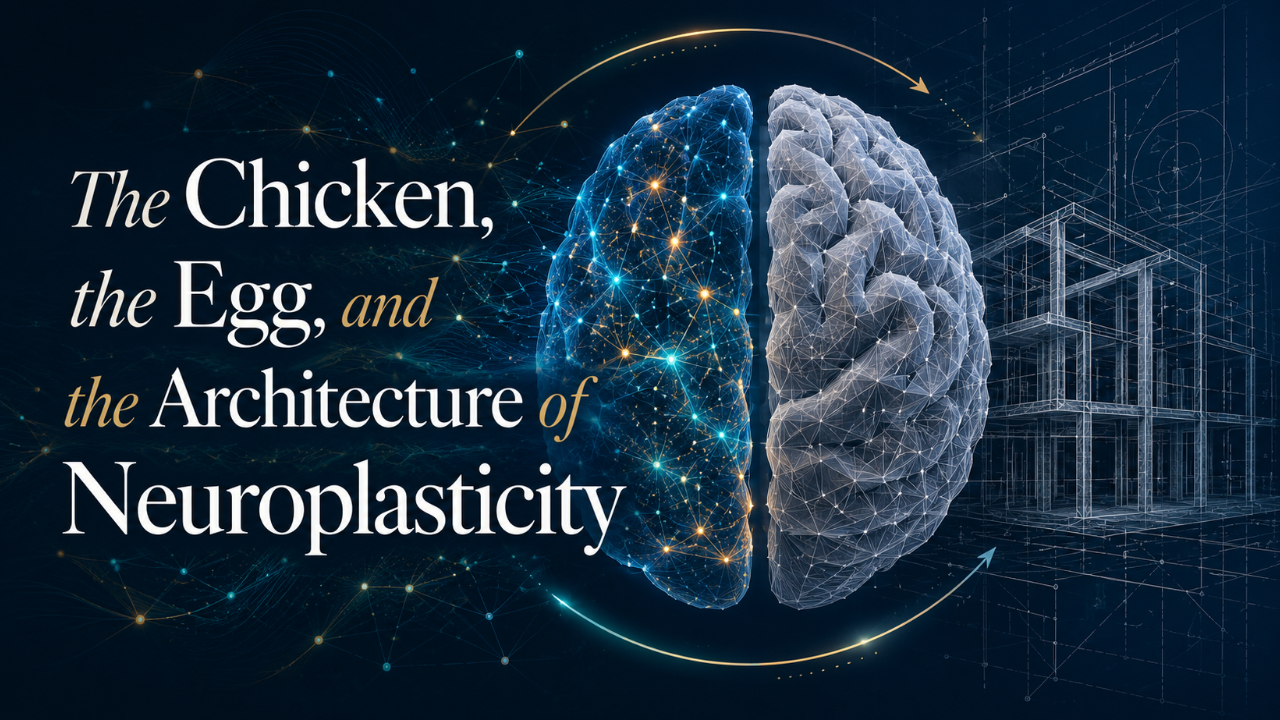
The Chicken, the Egg, and the Architecture of Neuroplasticity
By Michelle C. Eliason, MS, OTR/L
PhD Candidate in Rehabilitation Science
Research Note: This blog category is a space for reflections related to my doctoral research and evolving work in rehabilitation science. These posts are intentionally exploratory and provide a place to share questions, emerging connections, scientific curiosities, and informal thought processes as my research and understanding continue to develop.
There is a fundamental question in neuroplasticity research that remains unresolved:
What came first, the structural state or the functional state?
We frequently describe functional network reorganization as evidence of neuroplasticity. A region increases its activation. Connectivity between two regions strengthens. Recruitment shifts from one network to another. A compensatory network appears to emerge. These are meaningful observations, but they do not, by themselves, tell us what happened structurally to make that functional reorganization possible, nor do they establish whether functional change preceded structural change or emerged because the underlying structural architecture had already changed.
This distinction becomes particularly important because structural covariance and functional connectivity can look conceptually similar while representing fundamentally different phenomena. Structural covariance asks whether the morphology of one brain region systematically varies with the morphology of another, traditionally across individuals. Functional connectivity asks whether activity in one region systematically co-fluctuates with activity in another, generally across time within an individual. Both can therefore produce networks based on statistical relationships between regions, but the axis of covariance is different. One is describing coordinated morphology. The other is describing coordinated physiological activity. Similar network topology does not establish that they represent the same biological system. Empirically, structural covariance, synchronized maturational change, functional connectivity, and diffusion-derived anatomical connectivity demonstrate meaningful convergence, but also substantial divergence.
That leaves us with a chicken-and-egg problem. Does repeated functional co-activation eventually contribute to coordinated structural change? Does an existing structural architecture determine which functional configurations are possible? Do both processes influence one another continuously? Does the direction of that relationship change across development, learning, aging, injury, or neurodegenerative disease? The current evidence does not justify reducing this to a single directional pathway. In fact, recent work in preclinical Alzheimer's disease demonstrates that structural and functional connectivity can become decoupled, reinforcing the idea that functional organization cannot simply be assumed to reflect the state of the underlying structural system.
This also forces us to be more precise when we use the word neuroplasticity. Neuroplasticity is not simply increased activation on functional magnetic resonance imaging or a change in functional connectivity. Those observations may represent manifestations of plasticity, compensation, altered recruitment, network reweighting, or other physiological processes. Plasticity ultimately refers to the nervous system's capacity to alter its organization in response to experience, learning, injury, disease, or environmental demand. If we observe only the functional expression of that adaptation, however, we are observing only one level of the process.
Diffusion imaging adds an enormously valuable piece of information, but it does not completely solve this problem. Diffusion magnetic resonance imaging provides an indirect window into tissue microstructure and the organization of white matter pathways. Its measurements are influenced by fiber orientation, crossing fibers, axonal properties, myelination, extracellular water, pathology, acquisition parameters, and the particular reconstruction model being used. Tractography itself can produce different network estimates depending on methodological choices. It is therefore more accurate to think of diffusion imaging as another layer of the architecture rather than as a definitive map of the physical neural substrate.
I think that a useful analogy is a building. Functional connectivity tells us which rooms appear to be communicating. Diffusion imaging tells us something about the pathways through which those rooms may be connected, almost like examining the wiring running through the building. Structural morphometry tells us something different again: the condition and organization of the building itself.
Knowing that two rooms have functioning electrical wiring does not tell us whether the walls supporting those rooms are stable.
Consider identical wiring installed in two structures. One structure has a stable foundation, intact load-bearing walls, and substantial architectural reserve. The other has progressive structural deterioration. Its foundation is shifting. Load-bearing walls are weakening. Rooms are changing shape. Connections that were once viable are being placed under increasing structural constraint. The electrical diagrams might initially look remarkably similar, yet the future possibilities of those wiring systems are not equivalent because the structures supporting them are not equivalent.
Neurodegenerative disease makes this especially important. If cortical regions are progressively thinning, if coordinated patterns of morphology are reorganizing, or if relationships among structurally coupled regions are changing, then the substrate within which functional reorganization must occur is itself moving. The brain is not attempting to reorganize on a static scaffold. It is attempting to reorganize while the scaffold is changing. That should fundamentally alter how we interpret apparent 'compensation'.
An increase in functional connectivity in a structurally preserved network may represent something very different from the same increase in functional connectivity occurring within a network undergoing progressive structural destabilization. One may reflect adaptation supported by sufficient structural reserve. The other may represent an increasingly costly attempt to maintain performance as the available architecture deteriorates. Looking only at the functional image risks treating these two states as equivalent when biologically they may represent very different positions along the trajectory of disease.
This is why the jury is still out on the relationship between structural and functional states. We know they interact. We know their organization partially converges. We know structural pathways constrain functional communication to some degree. But we do not yet have a complete temporal or mechanistic account establishing when structural change drives functional reorganization, when functional activity contributes to structural remodeling, when the two change together, or when they begin to decouple.
If we are going to talk about an individual's capacity for neuroplasticity, particularly in progressive neurological disease, then functional reorganization alone may be insufficient. We also need to ask about the condition of the architecture in which that reorganization is occurring. Not simply: Can this network change? But, What structural system remains available to support that change, how coordinated is that system, and where along its structural trajectory is this individual when we are asking it to reorganize?
I believe that will take our efforts from identifying that plasticity is occurring to understanding how much viable substrate remains for plasticity to work with.