Interdisciplinary Team
Mar 15, 2024
Interdisciplinary Team
Rehabilitation ideally represents many disciplines

What Is an Interdisciplinary Team?
by Michelle C. Eliason, MS, OTR/L
Membership Resources: This article and its companion audio are free to read and listen to. Links throughout the article connect members of the Functional Cognition Lab to related printables, treatment tools, courses, and clinical resources that align with the topic being discussed. Membership also includes access to the full resource library and direct clinical support. Find out more about membership on the Membership Options Page
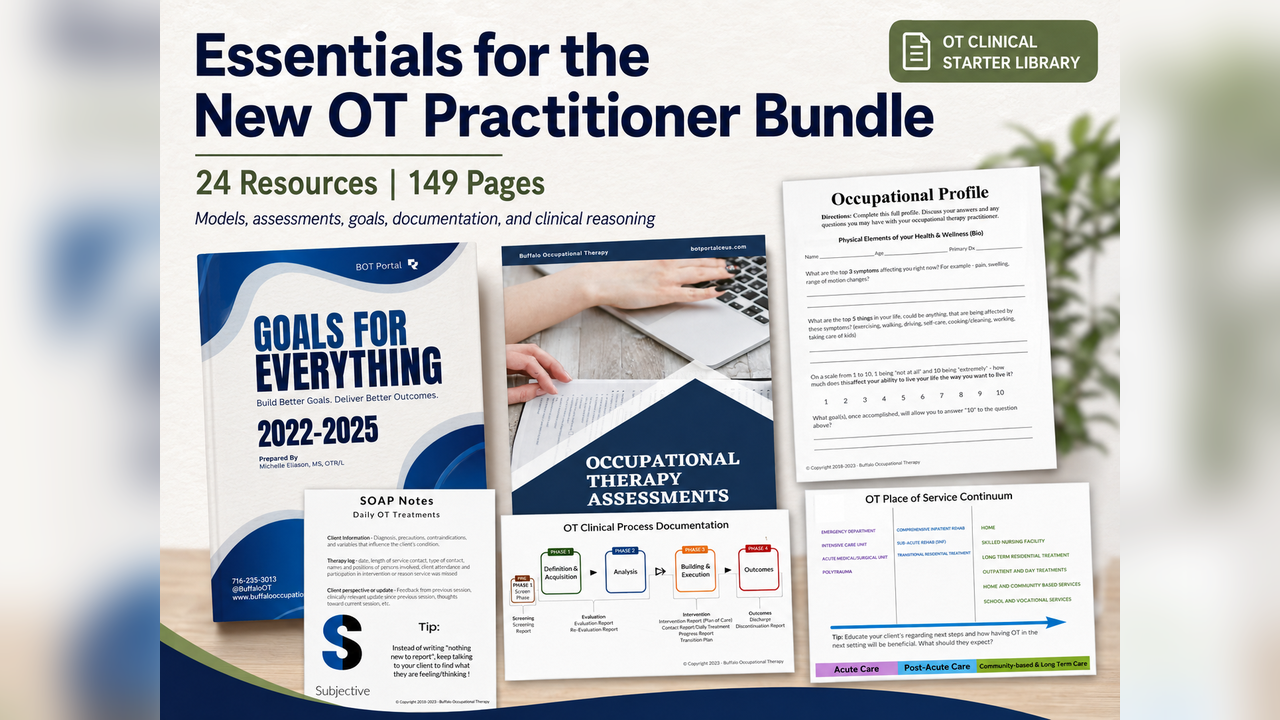
Just want the resources mentioned in this article?: Download the Essential Resources for New OT Practitioner Bundle
An interdisciplinary team is a group of professionals from different disciplines who work together to support a person with complex needs.
This type of teamwork is common in hospitals, rehabilitation centers, outpatient clinics, mental health settings, schools, skilled nursing facilities, and programs serving older adults or people with disabilities.
The team may include physicians, nurses, occupational therapy practitioners, physical therapy practitioners, speech-language pathologists, social workers, psychologists, dietitians, case managers, rehabilitation counselors, and other professionals.
Each team member brings a different area of training, clinical reasoning, and professional experience.
The goal is not simply to place several professionals in the same building. The goal is to coordinate care so the person receives a more complete and connected plan.
An interdisciplinary team focuses on the whole person. This may include:
- Physical health
- Mental health
- Cognition
- Communication
- Mobility
- Daily activities
- Social participation
- Family support
- Work or school roles
- Environmental barriers
- Discharge needs
Team members communicate regularly, share information, and coordinate their recommendations around the person’s needs and goals.
This may happen through team meetings, shared documentation, case conferences, discharge planning, or direct communication between professionals.
The team may also help ensure that care remains consistent when a person transitions from one setting to another, such as moving from a hospital to inpatient rehabilitation, home health, outpatient therapy, or community-based services.
When interdisciplinary care works well, the person should not feel like they are receiving several disconnected treatment plans.
They should feel like one team is working together.
Member Resource:
Is an Interdisciplinary Team the Same as a Multidisciplinary Team?
The terms interdisciplinary and multidisciplinary are often used interchangeably, but they do not always mean the same thing.
A multidisciplinary team includes professionals from several disciplines. Each professional may evaluate the person and develop recommendations from within their own area of practice.
The professionals may work alongside one another, but their treatment plans can remain relatively separate.
An interdisciplinary team takes coordination further.
The professionals communicate more intentionally, identify shared priorities, and integrate their recommendations into a coordinated plan of care.
A simple way to understand the difference is:
Multidisciplinary care means professionals work alongside one another.
Interdisciplinary care means professionals actively coordinate their expertise.
Both models may include the same professions. The difference is how closely the professionals communicate and integrate their work.
Member Resource: Interprofessional Value Handout
What Is an Example of an Interdisciplinary Rehabilitation Team?
Consider a person receiving rehabilitation after a stroke.
The person may have weakness, changes in muscle tone, balance problems, difficulty walking, cognitive changes, communication challenges, swallowing concerns, fatigue, and difficulty completing everyday activities.
No single profession can address every part of that situation.
An interdisciplinary rehabilitation team may include the following professionals:
Physician
The physician may be a physiatrist, neurologist, primary care physician, or another medical specialist.
The physician oversees medical management, evaluates the person’s diagnosis and medical stability, prescribes medications, orders testing, and coordinates medical treatment.
The physician may also help manage conditions such as pain, spasticity, seizures, cardiovascular risk, sleep problems, or other medical concerns that affect rehabilitation.
Nurse
The nurse monitors the person’s medical status and provides essential care throughout the rehabilitation process.
This may include:
- Monitoring vital signs
- Administering medications
- Providing wound care
- Supporting bowel and bladder management
- Monitoring skin integrity
- Educating the person and family
- Reinforcing safety recommendations
- Coordinating communication across the team
Nurses often observe the person across different times of day and during real daily routines. Their observations can provide valuable information about fatigue, cognition, safety, medication response, and functional performance.
Physical Therapist
The physical therapist evaluates and treats movement-related impairments that affect mobility and physical function.
This may include:
- Strength
- Balance
- Coordination
- Endurance
- Gait
- Transfers
- Joint mobility
- Pain
- Postural control
- Fall risk
Physical therapists use movement analysis, therapeutic exercise, mobility training, and other interventions to improve how safely and efficiently a person moves.
Their work may directly support the person’s ability to walk, transfer, navigate the home, climb stairs, and participate in daily life. Physical therapists work in the biospychosocial framework and also work toward maximizing functional performance in the tasks meaningful to their clients.
Occupational Therapist
The occupational therapy practitioner also evaluates and treats strength, balance, mobility, gait, coordination, endurance, upper-extremity function, lower-extremity function, cognition, perception, sensation, vision, and other factors affecting performance.
Occupational therapy is not limited to self-care activities, and physical therapy does not own movement.There is significant overlap between occupational therapy and physical therapy training and intervention. What distinguishes occupational therapy is its philosophical starting point and its use of occupation-centered reasoning and activity analysis.
The occupational therapy practitioner begins by identifying what the person needs, wants, or is expected to do.
This may include:
- Dressing
- Bathing
- Cooking
- Managing medication
- Returning to work
- Caring for children
- Driving
- Completing home responsibilities
- Participating in the community
- Returning to hobbies
- Managing routines
- Living independently
The OTP then analyzes the person, task, environment, habits, roles, routines, and performance demands to determine why participation is breaking down. The barrier may involve strength, gait, balance, cognition, vision, sensation, pain, emotional regulation, executive functioning, environmental design, or a combination of factors.
The OTP may directly address body functions and movement, but those interventions are connected to occupational performance. This occupation-centered approach and the ability to analyze the full activity are central to occupational therapy.
Speech-Language Pathologist
The speech-language pathologist evaluates and treats communication, cognition, and swallowing.
Following a stroke, this may include:
- Speech production
- Language comprehension
- Word finding
- Reading
- Writing
- Memory
- Attention
- Executive functioning
- Social communication
- Swallowing safety
Speech-language pathologists may work with the person to improve communication, use compensatory strategies, safely consume food and liquids, and participate more effectively in daily conversations and activities.
Social Worker or Case Manager
The social worker or case manager helps address the social, financial, emotional, and logistical factors affecting recovery.
This may include:
- Discharge planning
- Insurance concerns
- Transportation
- Caregiver support
- Community resources
- Housing needs
- Equipment access
- Mental health support
- Long-term care planning
These professionals help connect the clinical plan to the realities of the person’s life outside the treatment setting.
How Does an Interdisciplinary Team Work Together?
An interdisciplinary team should do more than exchange updates.
The team should work toward shared outcomes.
For example, a person preparing to return home after a stroke may have the shared goal of safely completing the morning routine and leaving the home for medical appointments.
Different team members may contribute in different ways:
- The physician may address medical stability and medication management.
- The nurse may reinforce medication routines, safety precautions, and health-management education.
- The physical therapist may address transfers, walking, balance, and stair navigation.
- The occupational therapy practitioner may analyze the entire morning routine, home setup, cognitive demands, dressing process, bathroom safety, mobility needs, caregiver support, and environmental barriers.
- The speech-language pathologist may address communication, memory, sequencing, or swallowing concerns.
- The social worker may coordinate transportation, home services, equipment, and caregiver resources.
The professions may overlap in what they observe and treat.
That overlap is not automatically a problem. The value comes from bringing different reasoning frameworks to the same functional problem.
What Is a Transdisciplinary Team?
A transdisciplinary team goes beyond coordination.
In a transdisciplinary approach, professionals develop a more integrated way of understanding and addressing the person’s needs.
The boundaries between disciplines become more flexible, although legal scope of practice, competence, and professional responsibility must still be respected.
Team members may intentionally reinforce selected strategies introduced by another discipline.
For example, several team members may use the same:
- Transfer sequence
- Communication cues
- Memory system
- Positioning strategy
- Behavioral support plan
- Visual schedule
- Caregiver instructions
- Safety language
This is sometimes described as role sharing or role release. It does not mean that professionals abandon their discipline or practice outside their competence. It means the team agrees that certain strategies should be carried across settings and sessions so the person receives consistent support.
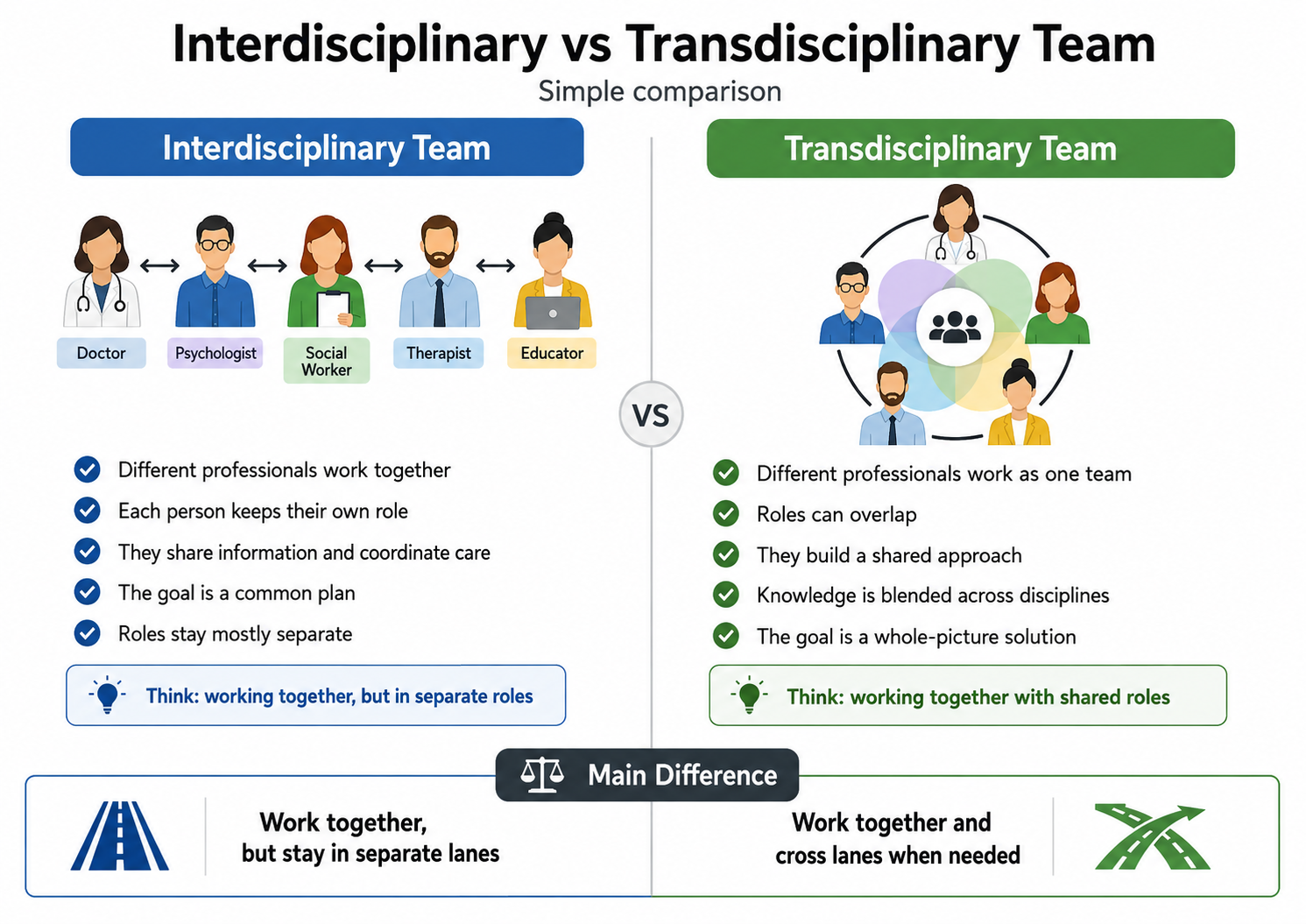
What Is the Difference Between an Interdisciplinary and Transdisciplinary Team?
Interdisciplinary Team
In an interdisciplinary approach, professionals from different disciplines work together toward shared goals.
Each discipline maintains its professional identity and contributes its specialized knowledge.
The team communicates, coordinates care, and integrates recommendations into an overall plan.
The focus is on:
- Shared information
- Coordinated goals
- Integrated planning
- Respect for each discipline’s expertise
- Consistent care across the team
Transdisciplinary Team
In a transdisciplinary approach, professionals integrate their knowledge more deeply and may share selected strategies across disciplines.
The team develops a shared framework for understanding the person’s needs.
The focus is on:
- Breaking down professional silos
- Building a shared approach
- Reinforcing strategies across settings
- Creating consistency
- Integrating multiple professional perspectives
- Supporting the person through one coordinated system
A simple way to remember the difference is:
Interdisciplinary teams coordinate their expertise.
Transdisciplinary teams integrate their expertise and may share selected strategies.
My Unsolicited Opinion
While I remain steadfast in my desire to protect the occupational therapy scope of practice, I believe the ideal approach to healthcare is transdisciplinary. Nobody benefits from professions operating in silos. Patients and families benefit when professionals trust one another, communicate clearly, respect each other’s expertise, and reinforce important strategies across the entire plan of care.However, I do not think fully transdisciplinary healthcare is always realistic within the current United States medical model.
The natural and often unspoken default of the system is hierarchical. Certain professions are given greater authority, visibility, and reimbursement, while other professions are expected to justify their existence repeatedly. This can create competition between disciplines rather than collaboration.I am not saying this is true in every workplace or on every team.I am saying the structure of healthcare often encourages it. If occupational therapy practitioners are not advocating for themselves, clearly communicating their distinct value, and protecting their scope of practice, we risk losing our voice on the team and our place at the table.
This is part of what I believe has happened to occupational therapy in many healthcare settings. Our scope is broad, but it is often poorly understood. Our training overlaps substantially with other rehabilitation professions, but our philosophy, activity analysis, and occupation-centered reasoning are not always clearly communicated. When we reduce occupational therapy to dressing, bathing, or upper-extremity exercises, we make it easier for the rest of the healthcare system to misunderstand and undervalue us.
Occupational therapy practitioners can address movement, mobility, gait, strength, balance, cognition, vision, sensation, emotional regulation, environmental barriers, and many other factors required for occupational performance. The distinction is not that we are prohibited from addressing the same body functions as another profession.
The distinction is how we analyze the problem, how we connect it to meaningful occupation, and how we understand the relationship between the person, the task, and the environment. I believe occupational therapy can strengthen its position within interdisciplinary and transdisciplinary care.
However, that will require us to clearly define our value, demonstrate our outcomes, protect our scope, and participate confidently in team decision-making. Collaboration does not require occupational therapy to become smaller.The best collaboration happens when every profession understands what it contributes and has the confidence to bring that contribution fully to the table.
About the Author
Michelle Eliason, MS, OTR/L is an occupational therapist, rehabilitation researcher, educator, and founder of BOT Portal and Buffalo Occupational Therapy. Her clinical and scholarly work focuses on neurological rehabilitation, functional cognition, cognitive-motor performance, aging, and the translation of rehabilitation science into practical occupational therapy evaluation, intervention, and clinical reasoning.
Learn more about : Michelle C. Eliason, MS, OTR/L
Continue Learning With Us
Did you find this information helpful? Please share this article with another occupational therapy practitioner, student, educator, or rehabilitation professional who may benefit from it.
Would you like access to the clinical resources discussed throughout this article? Explore our membership options to find the level of support that works best for you.
Looking for a more formal learning and mentorship experience? Learn more about the Functional Cognition Lab Mentorship Program.
You can also explore our AOTA-approved courses and clinical resource packages for additional education, treatment resources, and practical tools you can use in rehabilitation practice.
Interested in receiving free functional cognition education each week? Subscribe to the Functional Cognition Lab Newsletter.