Seated Upper Body Activity with Gross and Fine Movements
Jun 07, 2024
Seated Upper Body Activity with Gross and Fine Movements
by Michelle C. Eliason, MS, OTR/L
Dear Members, check out your Membership Library where you have access to the Resource Bundles with your membership. I would also like to encourage you to leave a Marco Polo message for asynchronous discussion about how this content may currently relate to your clinical practice or education!
Membership Resources: This article and its companion audio are free to read and listen to. Links throughout the article connect members of the Functional Cognition Lab to related printables, treatment tools, courses, and clinical resources that align with the topic being discussed. Membership also includes access to the full resource library and direct clinical support. Find out more about membership on the Membership Options Page
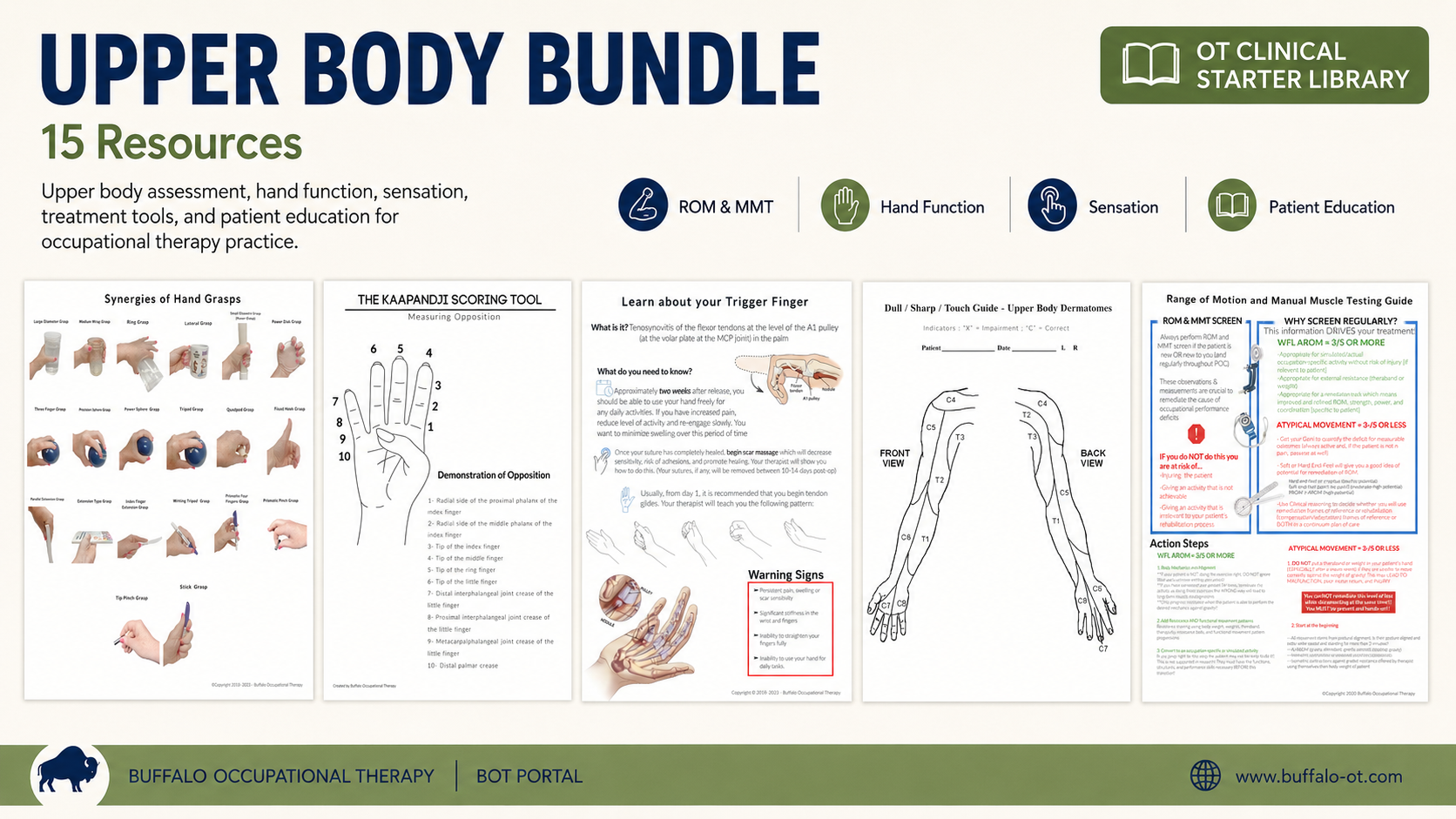
Just want the resources? Download the Upper Body Bundle
In occupational therapy (OT), leveraging simple, versatile tools is crucial, especially in outpatient settings where patients may not have access to expensive or specialized equipment at home. This article explores an effective, minimalist approach to using everyday tools for tone inhibition and movement reintegration in patients with motor control issues.
Minimalist Mentality in Outpatient OT
Occupational therapists often need to adopt a minimalist approach, using tools that patients can easily find and afford. This ensures that therapeutic activities can be replicated at home, facilitating continuous practice and progress. The focus should be on maximizing the utility of simple, multipurpose tools.
Activity Analysis and Occupational Context
When selecting activities, it is essential to differentiate between activities (decontextualized tasks) and occupations (tasks within a person’s context). For instance, using a tool like a power web can be adapted to work on specific performance skills, such as the three-point grasp, which is crucial for many daily activities like writing or buttoning a shirt.
Implementing the Activity
Tools Needed:
- Power Web: A resistive web used to provide resistance during hand exercises.
- Pipe Connectors: Small connectors available at hardware stores, used to enhance the difficulty of the exercise.
- Bingo Disks or Circular Targets: Used to create visual targets for the activity.
Setup:
- Stabilize the Power Web: The unaffected side of the patient’s body stabilizes the power web, reducing associated reactions (unintended movements in other parts of the body).
- Place Targets: Spread out bingo disks or targets, particularly on the side of hemispatial neglect if present, to encourage visual scanning and gaze shifting.
- Grading the Task: Adjust the difficulty by varying the resistance of the power web and the positioning of the targets.
Addressing Tone Inhibition and Movement Reintegration
Inhibition of Tone:
- Start by working on reducing abnormal muscle tone (hypertonia) in the upper extremity.
- Focus on proximal to distal movements, ensuring control over shoulder, elbow, and wrist movements before progressing to hand movements.
Reintegration of Movement:
- Encourage patients to perform movements that integrate typical motor patterns.
- Use the power web to practice fine motor control, focusing on specific hand synergies like the three-point grasp.
- Emphasize posture and alignment, ensuring patients maintain proper body mechanics throughout the exercise.
Enhancing Fine Motor Control
- Fine Motor and Gross Motor Coordination: The exercise helps in combining fine motor control (precise hand movements) with gross motor control (larger arm movements).
- Muscle Control: Patients need to manage muscle power, tone, and endurance to perform the task effectively.
- Motor Learning: Encourage patients to focus on intentional, controlled movements, reinforcing the neural pathways required for motor tasks.
Practical Considerations
- Feedback and Adjustment: Continually ask patients if they experience discomfort and adjust the activity as needed.
- Cost-Effective Tools: The power web, pipe connectors, and bingo disks are affordable, making this approach feasible for both clinics and home settings.
- Documenting Progress: Use the BOT portal to track hand synergies and ensure consistent terminology and documentation.
About the Author
Michelle Eliason, MS, OTR/L is an occupational therapist, rehabilitation researcher, educator, and founder of BOT Portal and Buffalo Occupational Therapy. Her clinical and scholarly work focuses on neurological rehabilitation, functional cognition, cognitive-motor performance, aging, and the translation of rehabilitation science into practical occupational therapy evaluation, intervention, and clinical reasoning.
Learn more about : Michelle C. Eliason, MS, OTR/L
Continue Learning With Us
Did you find this information helpful? Please share this article with another occupational therapy practitioner, student, educator, or rehabilitation professional who may benefit from it.
Would you like access to the clinical resources discussed throughout this article? Explore our membership options to find the level of support that works best for you.
Looking for a more formal learning and mentorship experience? Learn more about the Functional Cognition Lab Mentorship Program.
You can also explore our AOTA-approved courses and clinical resource packages for additional education, treatment resources, and practical tools you can use in rehabilitation practice.
Interested in receiving free functional cognition education each week? Subscribe to the Functional Cognition Lab Newsletter.