6 Tips for Occupational Therapy Students
Jun 22, 2023
6 Tips for Occupational Therapy Students
Best Advice from a Seasoned Occupational Therapist
by Michelle C. Eliason, MS, OTR/L
Membership Resources: This article and its companion audio are free to read and listen to. Links throughout the article connect members of the Functional Cognition Lab to related printables, treatment tools, courses, and clinical resources that align with the topic being discussed. Membership also includes access to the full resource library and direct clinical support. Find out more about membership on the Membership Options Page
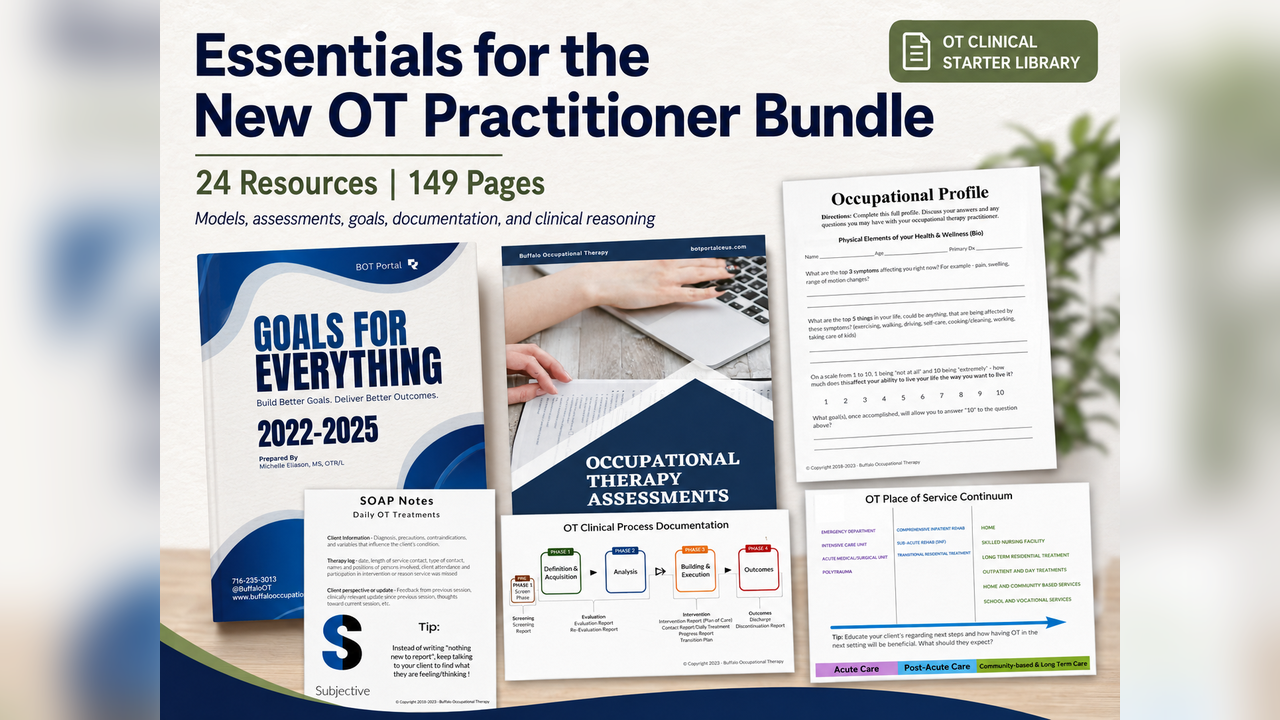
Just want the resources mentioned in this article?: Download the Essential Resources for New OT Practitioner Bundle
As an occupational therapy student, there are realities your program may or may not be discussing openly. Reimbursement pressures affect therapy services. Employment opportunities and salaries vary significantly by region and setting. Occupational therapy practitioners are sometimes placed in roles that underuse their education, reasoning, and full scope of practice. Some hospital systems employ only a small number of occupational therapy practitioners. Some outpatient clinics employ substantially more physical therapy practitioners than occupational therapy practitioners. Many members of the public still do not understand what occupational therapy is, what we do, or why advanced education is required to do it well.
This is the problem we are facing in the clinical world.
So, what is the solution?
The solution is you.
The solution is the next generation of occupational therapy practitioners who are willing to begin doing better from the very start. The solution is a collective student body that agrees to outlearn, out-advocate, outgrow, and eventually outperform the practitioners and educators who came before them.
That is not disrespectful. That is progress.
Every generation should want the next generation to know more, question more, and move the profession forward. From our current circumstances, it is very clear that occupational therapy needs to continue course correcting.
So, what is my top advice for occupational therapy students?
Advice for Occupational Therapy Students
-
Join the occupational therapy conversation in the clinical world immediately.
-
Read the ACOTE Standards listed in your course materials.
-
Understand the difference between how a program interprets a standard and what the standard actually requires.
-
Read your textbooks to understand the information and how it applies to the occupational therapy process.
-
Create systems, structure, and organization from Day 1.
-
Develop study habits that help you understand, integrate, and retain information.
1. Join the Occupational Therapy Conversation
I remember telling a program director, when I was working as an adjunct, that I strongly believed occupational therapy students should become involved in professional communities and social media conversations as early as possible. Students need strong sources of encouragement, realistic feedback, mentorship, and exposure to what is actually happening in clinical practice.
She looked me square in the face and said she did not recommend it. Her concern was that students would hear about the difficulties in the profession, become discouraged, and leave the program. The thinking was essentially, “If they do not know about it, they will not worry about it.”
That is not okay.
Students should not graduate and experience complete shell shock because the profession they entered looks different from the profession they were shown in school.
Get plugged into professional communities. Follow occupational therapy organizations, clinicians, researchers, educators, advocates, specialty groups, and professional discussions. Use social media thoughtfully. Join groups, attend events, listen to podcasts, participate in continuing education, and pay attention to conversations about reimbursement, policy, documentation, scope of practice, evidence, advocacy, and emerging areas of care.
Always keep your finger on the pulse of what is actually happening in your profession.
Many professors are excellent educators and remain highly involved in clinical practice. Others primarily work in academia and may have less exposure to the daily realities of current clinical environments. This does not mean they have nothing valuable to teach you. It means you should build a broad professional network rather than relying on any one person or program to prepare you for everything.
Protect yourself from the shock of graduating into a profession you may not have been fully prepared to enter. It is better to understand the challenges early so you can prepare to join the conversation, advocate for your role, and clearly explain your value in a healthcare system that may not automatically understand it.
Take it from experience...
Although we may have concerns or disagreements with large professional organizations, it is still important to understand their role. Follow updates from AOTA, your state occupational therapy association, regulatory boards, accreditation organizations, and other groups influencing practice. Whether or not you agree with every decision, you need to understand the systems in which occupational therapy operates.
You cannot effectively advocate within a system you do not understand.
2. Begin Building Your Professional Vocabulary
Here is another important part of joining the conversation. Begin building your professional lexicon immediately.
Learn medical terminology. Learn the language of rehabilitation, anatomy, neuroscience, psychology, healthcare policy, documentation, research, and occupational therapy theory. Practice explaining what you observe using accurate clinical language.
Yes, it may feel awkward at first. Yes, you may occasionally annoy people. However, you have several years to transform yourself into a healthcare professional with an entirely new vocabulary as part of your common language.
The only way to become comfortable with professional terminology is to begin using it.
At the same time, remember that being able to use complex terminology is not the same as communicating well. You must also learn how to translate that terminology into language that patients, families, students, administrators, and other professionals can understand.
A strong occupational therapy practitioner can speak both languages.
3. Read the ACOTE Standards
The Accreditation Council for Occupational Therapy Education, or ACOTE, establishes educational standards for occupational therapy and occupational therapy assistant programs.
Read them.
Do not assume that every assignment, course structure, or program requirement is written word for word in the ACOTE Standards. Programs are responsible for demonstrating that they meet accreditation requirements, but each program may interpret and implement those requirements differently.
Creating and maintaining an accredited program is an incredibly rigorous process. I do not envy the faculty and administrators responsible for ensuring that every standard is addressed, implemented, and documented. They are balancing accreditation requirements, university policies, faculty resources, fieldwork expectations, student needs, and educational outcomes.
They deserve grace.
However, students also deserve transparency.
If you have a concern about a course requirement, assignment, policy, fieldwork expectation, or program structure, review the current ACOTE Standards and then schedule a respectful conversation with the appropriate faculty member or program director.
Ask where the requirement is coming from.
Ask how the program is interpreting the standard.
Ask what learning outcome the requirement is intended to support.
Ask whether there are alternative ways to meet that outcome.
Do not immediately assume that ACOTE explicitly requires every individual policy or assignment included in your program. Sometimes the requirement comes from the university. Sometimes it comes from the program’s interpretation of an accreditation standard. Sometimes it is simply the way a course has historically been structured.
I want to be very clear. I am not encouraging you to become combative, argumentative, or chronically difficult.
I am encouraging you to become an active participant in your education.
You are investing a great deal of time, energy, and money into becoming an occupational therapy practitioner. Do not move through your program blindly. Ask thoughtful questions. Seek clarification. Understand the purpose behind what you are being asked to do.
Be respectful, but also be informed.
4. Read Your Textbooks to Understand
From a professor’s perspective, I do not understand why so many students refuse to read the assigned text.
There is far more information in your program than any professor could possibly teach during class. Much of the material will be completely new to you. The textbook gives you context, examples, explanations, and connections that cannot always fit into a lecture.
Do not depend entirely on PowerPoint slides, study guides, or handouts.
Those materials are often summaries. They may help you identify major concepts, but they are not always enough to help you understand the material deeply.
Read the required text. Use supplemental resources. Look up concepts you do not understand. Study to understand, not simply to pass the next exam.
Everything you learn in your program is part of a continuum. The information builds on itself.
Your anatomy and neuroscience courses connect to assessment and intervention. Your psychology courses connect to behavior, motivation, cognition, and therapeutic use of self. Your research courses connect to evidence-based practice. Your activity analysis courses connect to nearly everything you will eventually do as an occupational therapy practitioner.
The biomedical courses do connect to occupational therapy, even when the connection is not immediately obvious or clearly explained.
One of the best recommendations I can give you is to learn as much as possible in every class, regardless of your professor’s teaching style or ability.
You have access to textbooks, online education, journal articles, professional communities, mentorship, study groups, and continuing education. Use them.
Do not simply “get through” a class.
When you only get through a class, you may be setting yourself up to struggle later when you need to integrate that knowledge into clinical reasoning. The content you are tempted to forget after the exam may become the exact information you need when evaluating a patient, selecting an assessment, interpreting symptoms, choosing an intervention, or explaining your reasoning to another healthcare professional.
Learn as much as you can. Figure out how the information connects to your other courses. Then take it one step further and imagine how you would apply it in practice.
While we are discussing textbooks, please stop throwing away your notes and giving away every textbook as soon as you graduate.
I cannot tell you how many times my old materials have helped me solve a problem, review a forgotten concept, prepare a lecture, develop an intervention, or explain something to a patient or student.
Save the materials that may support your future clinical practice.
You do not need to keep every scrap of paper forever, but you should create a thoughtful system for preserving valuable resources.
5. Create Systems, Structure, and Organization From Day 1
This builds on the previous point, but it deserves its own attention.
Begin developing a system for saving study materials, clinical examples, professor explanations, assignments, references, intervention ideas, assessments, and resources.
I use cloud-based storage for almost everything because it is searchable, accessible, and easy to organize. You can use Google Drive, Microsoft OneDrive, Notion, a reference manager, or another secure and reliable platform.
The specific platform matters less than the system.
One option is to maintain a master document for your entire program using headings and an automatically generated table of contents. You can organize information by semester, course, diagnosis, setting, assessment, intervention, theory, or practice area.
Another option is to create folders for each year, semester, class, and topic.
You could also create a personal clinical knowledge base that grows alongside you. For example, you might have sections for:
-
Documentation language
-
Frames of reference
-
Models of practice
-
Anatomy and neuroscience
-
Research articles
-
Fieldwork lessons
-
Questions to revisit
The opportunities for organization are endless.
Your system does not need to be beautiful. It needs to be usable.
The goal is to help your future self retrieve information, recognize connections, and continue building on what you already know.
Creating systems, structures, and organizational habits will help you put everything together.
Occupational therapy practitioners are big-picture analysts. We look at the person, the environment, the occupation, the context, the barriers, the supports, and the meaning behind performance.
Train your brain to see the big picture while you are still learning all the small parts.
If you are a new occupational therapy student, welcome to the journey! Be sure to check out the student resources on BOT Portal!
6. Develop Effective Study Habits
Figure out how you learn best.
You may prefer writing, drawing, listening, speaking, practicing, teaching, moving, or using a combination of methods. Do not become overly attached to one learning-style label, but pay attention to the strategies that actually help you understand and recall information.
When I was in school, I used nearly every method available. I wrote everything down. I made notecards and outlines. I drew pictures and diagrams. I talked myself through information while walking around. Then I taught the material to an invisible classroom.
Those methods helped me get through my occupational therapy program, and I still use many of them today.
The important question is not simply, “What kind of learner am I?”
The better question is, “What study method helps me learn this specific type of information?”
Anatomy may require diagrams and repeated labeling. Clinical reasoning may require case studies. Documentation may require practice. Research methods may require working through examples. Evaluation skills may require observation, repetition, and hands-on experience.
Different material may require different strategies.
You need to understand how you learn so you can give yourself the best chance of absorbing and integrating a massive amount of information.
You will continue using these learning strategies throughout your career.
Occupational therapy school is only the beginning.
Occupational therapy practitioners are lifelong learners. We are expected to use evidence, adapt to new information, educate patients and families, improve health literacy, and adjust our practice as healthcare changes.
To teach it, explain it, or apply it, we must first learn it.
Final Thoughts
I hope this advice helps you as you begin or continue your journey through occupational therapy school.
Take it one day at a time. Take it one assignment, one class, one fieldwork experience, and one step at a time.
Most importantly, give yourself grace. Give your classmates grace. Give your professors grace upon grace.
Occupational therapy school is aggressive. It is intensive. It is straight-up hard.
You are learning to think differently, communicate differently, observe differently, and understand people in ways you may never have considered before.
However, if you give yourself the opportunity to remain curious, disciplined, organized, and engaged, you may witness one of the greatest evolutions of yourself.
You are not only trying to graduate.
You are becoming an occupational therapy practitioner.
And this profession needs you to become a good one.
About the Author
Michelle Eliason, MS, OTR/L is an occupational therapist, rehabilitation researcher, educator, and founder of BOT Portal and Buffalo Occupational Therapy. Her clinical and scholarly work focuses on neurological rehabilitation, functional cognition, cognitive-motor performance, aging, and the translation of rehabilitation science into practical occupational therapy evaluation, intervention, and clinical reasoning.
Learn more about : Michelle C. Eliason, MS, OTR/L
Continue Learning With Us
Did you find this information helpful? Please share this article with another occupational therapy practitioner, student, educator, or rehabilitation professional who may benefit from it.
Would you like access to the clinical resources discussed throughout this article? Explore our membership options to find the level of support that works best for you.
Looking for a more formal learning and mentorship experience? Learn more about the Functional Cognition Lab Mentorship Program.
You can also explore our AOTA-approved courses and clinical resource packages for additional education, treatment resources, and practical tools you can use in rehabilitation practice.
Interested in receiving free functional cognition education each week? Subscribe to the Functional Cognition Lab Newsletter.